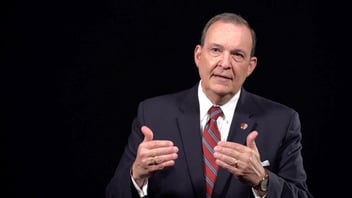
Dr. Bruce Baugus preaches on Luke 3 and the second coming of Christ in chapel at RTS Jackson. The message is entitled "He Is Coming." Hear the Word of the Lord from Luke 3:1–20:
Now in the fifteenth year of the reign of Tiberius Caesar, Pontius Pilate being governor of Judea, and Herod being tetrarch of Galilee, and his brother Philip tetrarch of Ituria and of the country of Trachonitus, and Lysanius the tetrarch of Abilene (when Annas and Caiaphas were the high priests) the word of God came unto John, the son of Zacharias, in the wilderness. And he came into all the coasts about Jordan, preaching the baptism of repentance for the remission of sins, as it is written in the book of the sayings of Isaiah the prophet, which saith, “The voice of him that crieth in the wilderness is, ‘Prepare ye the way of the Lord: make his paths straight. Every valley shall be filled, and every mountain and hill shall be brought low and crooked things shall be made straight, and the rough ways shall be made smooth, and all flesh shall see the salvation of God.’“ Then said he to the people that were come out to be baptized of him, “O generations of vipers, who hath forewarned you to flee from the wrath to come? Bring forth therefore fruits worthy amendment of life, and begin not to say with yourselves, ‘We have Abraham to our father’: for I say unto you that God is able of these stones to raise up children of Abraham. Now also is the axe laid unto the root of the trees: therefore, every tree which bringeth forth not good fruit shall be hewn down, and cast into the fire.” Then the people asked him, saying, “What shall we do then?” And he answered and said to them, “He that hath two coats, let him part with him that hath none: and he that hath meat, let him do likewise.” Then came three Publicans also to be baptized, and said under unto him, “Master, what shall we do?” And he said unto them, “Require no more than that which is appointed unto you.” The soldiers likewise demanded of him, saying, “And what shall we do?” And he said to them, “Do violence to no man, neither accuse any falsely, and be content with your wages.” As the people waited, and all men mused in their hearts of John, if he were not that Christ. John answered, and said to them all, “Indeed, I baptize you with water, but one stronger than I comes, whose shoes I am not worthy to unloose. He will baptize you with the Holy Ghost and with fire, whose fan is in his hand, and he will make clean his floor, and will gather the wheat into his garner, but the chaff he will burn up with fire that never shall be quenched.” Thus then exhorting with many other things, he preached unto the people. But when Herod the tetrarch was rebuked of him, for Herodias, his brother Philip’s wife, and for all the evils which Herod had done, he added yet this above all, that he shut up John in prison.Thus ends the reading of the Holy Scriptures. The grass withers and the flower fades, but the Word of our God will stand forever. Bruce Baugus: You may be seated. Our theme, though I won’t promise it will be followed every week, for this year’s chapel season is the person and the work of Christ as drawn from the Gospel accounts. And you can think of today’s sermon as the first installment or as an introduction to that. When Tiberius was reigning, when Pontius Pilate had become governor of Judea, and Herod the Great’s sons were tetrarchs of the surrounding districts, while Annas and Caiaphas were in their high priesthoods, it happened. In other words, this is history. Luke is writing historiography here. And Luke wants us to know that in the midst of the ordinary, mundane circumstances in the real world, as people went about their daily routines and their daily business, it happened. It actually happened. These events really took place. But note exactly what in this passage that event is. We might expect any historian to tell us of the peculiar ministry of John the Baptist, the things that made his life and his work curious, noteworthy, and the trouble he got into, and the things that he preached and said, and how he came to an end. But that’s not exactly what Luke is saying happened here, although all those things are included. What happens, Luke insists, is that the Word of God came to John in the wilderness.
John Announces Christ’s Coming of Judgment and Salvation
This is a classic prophetic formula. It’s very familiar to us, of course, from the Old Testament. We may be reading about John, a son of Zechariah, but Luke wants us to have no misunderstanding about the significance of his life and his work, about his ministry or who the primary actor is. God is stirring. He is up to something. And that something is extraordinarily weighty, so much so that all the drama of Roman rule and Jewish intrigue is merely background. Tiberius, Pontius Pilate, Annas, and Caiaphas are not the central actors in history. Their rise, their reigns, their falls may be good stories in themselves, but here they fade to so many extras in the drama of redemptive history, for God is stirring. He is up to something. He’s beginning to act again with saving intent. There are echoes of the exodus around, and the expectations of the people are rising, and God is remembering his people. He is taking concrete actions; fulfilling promises that he made long ago. The people have some sense of this. It’s not lost on them. They may not know exactly what’s up and what the details mean at this moment, but they’re going to him, and they sense that God is doing something special, something unusual, out of the ordinary. And this is his next act. His prophet is in the wilderness, crying out to the people, “Prepare the way of the Lord. Be baptized with the baptism of repentance for the forgiveness of sins.” John’s message is actually quite simple. It can be summarized in one word: erchetai. He is coming.All flesh will see the salvation of God, but only some will be saved.But this one word is exploding with implications. Universal redemptive, world historical, as Hegel might put it, implications. All flesh will see the salvation of God, but only some will be saved. This is the Word of God spoken by John. A great upheaval is about to enter into the settled order. The salvation and judgment of God is about to fall upon us. This is how Mary, this is how Zechariah, this is how Simeon understood it and how they tell it. And it’s certainly how John envisions the coming events, and Luke, too, we might note. The day of the Lord appears to be breaking. The great reckoning is already at hand. He is coming. The axe is laid to the root. The Holy Spirit is at his command. Think of that. And his winnowing fork is in his hand. He is coming. Salvation goes before him, and an unquenchable fire follows close behind. And the call is going out to all flesh to prepare the way of the Lord. The message is not the fancy of an overheated imagination on John’s part. It is not the mere enthusiasm that is speaking here, soon to be dashed and disappointed and brought low by a reality that does not live up to the billing. This is the Word of God. This is God’s own statement on the meaning and significance of what’s going down and what’s soon to come. He is coming. His winnowing fork is in his hand, and no one can stop him. We are impotent before him. He is coming, ready or not. Like the deadline on that term paper when the days and hours are running away from you, or like the baby in the womb whose time has come and you can’t stop it now. No more time to delay. No more way to prepare any longer for death. He is coming, and no one can stop him. Not in the days of John, nor in these few days that we have together here. The wrath of God is already falling from heaven on the unrighteous and the ungodliness of man. And all flesh is about to see his salvation: prepare the way of the Lord. “Repent and bear fruits in keeping with repentance,” John declares. “Look to the promise of forgiveness and the outpouring of the Spirit; be baptized with water today,” he proclaims, “and you will be baptized with the Spirit and with fire by him tomorrow.” This is John’s message. This is the Word of God.
John Is the Greatest Prophet Because of His Relationship to Christ
But Luke is not just drawing our attention to John’s prophetic ministry and the words that he has spoken here. There’s something else going on in this passage. Luke is drawing out a comparison that John himself makes. And this, it seems to me, is the center of Luke’s narrative on John. John is a prophet in the tradition of the great prophets who have come before him. Indeed, Jesus declares him to be the greatest of all prophets, and in fact, more than a prophet. “I tell you,” he says, “He [Jesus speaking of John here] is more than a prophet. He is the one of whom it was written, ‘Behold, I send my messenger before your face who will prepare your way before you.’ I tell you, among those born of women, none is greater.” That’s an astonishing statement, isn’t it? Among those born of women, none is greater than John. What about Elijah and Elisha? John greater than them? What about David? What of Moses? What of Abraham, the father of faith? On what grounds can such a statement be made about John? Obviously not on the grounds that we ordinarily associate with greatness. He possessed no political authority. He wielded no military power or might. He fathered no nation, he founded no institutions, and he wrote no books (greatness in an academic context, at least). His time in the public eye was exceptionally short-lived and his death was relatively obscure. If it had not been recorded in Scripture, would we know anything at all from history about him and what became of him? And it was downright humiliating. The reward of a dancing girl, a ruler who would not break his word.In John’s case, his exceptional greatness is derived from his exceptional relationship to the one who is coming.Is it merely that he was foretold? No, it can’t be this. People like Cyrus were foretold; the antichrist is foretold. This is not the kind of greatness that Jesus is ascribing to John. John’s greatness, I want to submit to you, is a derived greatness. It is not in himself. Greatness is not something we possess in ourselves in this way. It is something that’s derived. And I think in John’s case, his exceptional greatness is derived from his exceptional relationship to the one who is coming. John is more than a prophet. He is the forerunner of the Messiah. What all the other prophets longed to see, John has been chosen to have the privilege of introducing, of bringing about, of ushering in. He is not just foretold about in the Scriptures, but he is, as it were, the very opening act of the age of fulfillment, the leading edge of the eschaton, the herald of the Promised One, the last and greatest of Israel’s prophets. The people who went out to John sensed something of his greatness. They perceived that there was some sort of messianic significance to his ministry, and this raised their expectations all the higher as they heard him and as they considered him, so high that some even began to wonder if John himself were the Messiah. And this is the central comparison. John is not bashful. He is not caught up in his own glory. He is not flattered by the fact that some people might make this mistake. He is plain spoken and he says, “No, I’m not.” And that is a tragic mistake. For as great as John was, the greatest of all who had come before him—greater than Adam, greater than Elijah and David and Moses and Abraham, one of whom the world was not worthy—he himself professes that he is unworthy to untie the sandal of the one who is coming, to perform even the most menial act.
The greatest the human race has seen thus far of all those born of women is unworthy to perform the most menial of acts for the one who is coming.Think of this for a moment: the greatest the human race has seen thus far of all those born of women is unworthy to perform the most menial of acts for the one who is coming. Such is the surpassing greatness of Jesus Christ. John must yield before him. And if John, how much more Tiberius and Caiaphas and all the rest? He is coming, his winnowing fork is in his hand. Some will rejoice to see his day. Others will stubbornly and even violently resist yielding before him. Some will be gathered into his barns. Others will be dumped into unquenchable fire. It’s a sobering message. John, the friend of the bridegroom, rejoiced to see his day. His joy and life’s purpose was this very thing: to prepare the way of the Lord before him. To prepare the way of the one whose brilliance outshines the brightest of stars and lights in the night sky. This is the one who is coming, John declares. One whose sandal he is unworthy to untie. The one we gather to worship week by week in our churches, scattered around Jackson and surrounding areas on Sunday mornings, and also here Tuesday mornings, week by week, as we gather as a seminary community. And John’s call, the call of God, continues to ring in our ears: prepare the way of the Lord for he is coming, his winnowing fork is in his hand. Indeed, he has already come. He is here with us in this hall right now. And as I speak, he is gathering his harvest. He is cleaning his threshing floor. Prepare the way of the Lord.
We Need to Prepare the Way for the Second Coming of Christ
Jesus Christ is coming again, and no one can stop him or hinder him.This call is fully applicable to us for we too live in an age of anticipation. Jesus Christ is coming again, and no one can stop him or hinder him. For this we give thanks, but there are many who don’t. And yet his coming is more certain than death, for not all will die. But all will see him in his majestic glory. He is coming, and we are called to prepare and to be ready and watchful. But there is also a difference, because we live in an age of more complete fulfillment than did John. And just here, this is something significant. We do not merely anticipate the coming of Christ. We proclaim that Christ has already come, that he has lived among us, that he has lived a sinless life, that he has suffered and died on the cross on our behalf, and that he has risen again and ascended to the right hand of the Father. And so the call to us is to prepare, but it is to prepare for his return by receiving him right here, right now, by faith. For he is at this very moment in this worship hall with us, saving us from our sin and the wrath to come.
We do not merely anticipate the coming of Christ. We proclaim that Christ has already come.If Luther trembled when he, still marred by some degree of superstition, lifted up the elements in communion, how much more should we who have come to the reality of him present with us here? We have not received a message about one who is yet to come, but not yet come. We have received Jesus Christ himself who has already come and whose Spirit indwells us, and we have not been baptized with water alone. We who are in Christ have been baptized by him with the Holy Spirit and are able to be filled with the Spirit and to walk with the Spirit, and to bring forth not only fruits in keeping with repentance, but more than this: the fruits of the Spirit of Christ himself, who is being formed in you. So hear God’s call today: receive Jesus Christ by faith and be prepared for these are the days and this is the place in your life of preparation, preparation for ministry in the church and to God’s people. And as you well know or are quickly learning, there is much that goes into that preparation. Being prepared is your most fundamental duty or act at this time, your vocation at this time in your life. But there is a preparation that no amount of academic preparation can replace or satisfy, and that is the preparation of receiving Christ by faith. Day by day, week by week, year in and year out.
Come and drink deeply from the fountain of living water, and you will be a spring of life to others.Be prepared. Receive Christ as he meets you in worship with grace upon grace to lavish upon you, Sunday by Sunday as you gather with your church family and also Tuesday by Tuesday as you gather with the seminary community here. This is your preparation. Do not harden your hearts, and do not neglect or treat lightly the grace of God that is offered to you in the worship of God. For he calls you to himself and holds out an open arm to you to save you and to be your Lord. Receive him. His winnowing fork is in his hand. He is cleaning his threshing floor. Will you receive him, or will you be distracted and carried away by so many lesser things? Do not harden your hearts or forget your Lord. Come and drink deeply from the fountain of living water, and you will be a spring of life to others.