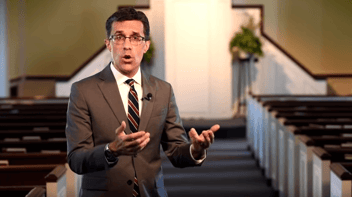
Start with Scripture
First, we need to start with the Bible. We need to start with a biblical theology of culture. Culture, in its simplest definition, is simply what we do with what God has made. It’s what human beings do with the created world, the natural world, and the resources that God has given us. And the Bible, of course, has a lot to say about the world and what God has made and what we are to do with the world that God has made. So, first of all, we want to start with Scripture, what Scripture gives us in terms of a biblical theology of culture.Culture is a Gift
Culture, in its simplest definition, is what we do with what God has made.Second, I think we want to recognize that culture is a gift from God. It’s not something to be feared, it’s not something to be inherently opposed, but in fact, culture is part of the goodness of creation. There is in Scripture what is called a cultural mandate for us to exercise dominion over the created world and to take the resources that God has given and use them for the glory of God and for the good of our neighbor.
Culture is Fallen
Thirdly, we need to recognize that culture is fallen. As well as a doctrine of creation, of course, Christianity has a doctrine of the fall, that this world is fallen in sin, mankind is fallen in sin. Of course, that has an impact on culture. And so the culture around us is always going to be a mixture of good and bad. And so we need to exercise great discernment to be able to tell the difference between a God-honoring culture and a God-dishonoring culture.All Culture is Religious
Fourth, I think we need to recognize that all culture is religious in nature because all culture reflects some sort of value system. So even a so-called secular culture—and we talk a lot about secular culture today—even a secular culture is in fact deeply religious at its root. And so there’s no such thing as a religiously neutral culture of any kind.Christians are Part of Culture
We are affected by the culture around us, and we also affect the culture around us.Fifth, we need to recognize that we ourselves as Christians are part of the culture. So we can’t separate ourselves from culture, we can’t isolate ourselves from culture. We are affected by the culture around us, and we also affect the culture around us, for better or for worse.
The Great Commission
Lastly, we need to view culture through the lens of the Great Commission. There are many things that we are called to do as Christians to serve God in this world. But the Great Commission, that great calling to take the good news of Christ to the nations, to make disciples of the nations, to bring the teaching of Christ to the nations and to build up the church, that has to be a priority for us. And the way that we relate to culture can help us in fulfilling the Great Commission and in some ways it can hinder us as well. I think that it’s important as Christians to recognize that the Great Commission is one of our priorities and is an important lens through which we think about our relationship to the culture around us.James Eglinton, The University of EdinburghThis is an outstanding piece of work. It contributes to our knowledge of Herman Bavinck in a new and significant way, bringing previously unknown archival sources to the fore. It explores Bavinck's epistemological concerns within a wider context of recent studies on his use of organicist thought, and makes a convincing argument that Bavinck's account of human knowing also follows an organicist paradigm. On that front, God and Knowledge manages to bring Bavinck into conversation with important figures past (Aquinas), then contemporaneous (Abraham Kuyper), and present.
Kevin J. Vanhoozer, Trinity Evangelical Divinity SchoolGod and Knowledge is an important contribution to the retrieval of Herman Bavinck's theology. Nathaniel Gray Sutanto confronts the 'two Bavinck' hypothesis that depicts him as torn between modernity and orthodoxy, then draws upon his organic motif to show that Bavinck's epistemology is both fully modern and fully orthodox – united in one person, without confusion, without separation.
Henk van den Belt, Vrije Universiteit AmsterdamThis study reshapes our views of Herman Bavinck's epistemology. He is neither simply modern nor simply Thomistic. For Bavinck, all true knowledge is organic; it rests in God's revelation. We do not invent the truth, but recognize it by rethinking the thoughts of the triune God expressed in creation and Scripture.
George Harinck, The Neo-Calvinism Research InstituteNathaniel Gray Sutanto convincingly argues that the epistemology of Herman Bavinck and his deployment of historical sources is structured by the organic motif. He thus succeeds, in a very lucid way, in presenting Bavinck as an eclectic and creative thinker, who opened new avenues for the Reformed theological tradition in modern times.
David Fergusson, University of EdinburghThe principle of unity in diversity was a vital organizing principle in Herman Bavinck's theology. Here Nathaniel Gray Sutanto skilfully explores its epistemological application to the subjective act of knowing and to the unity of the sciences as an organic whole. This is an important addition to the burgeoning secondary literature on Bavinck's work.