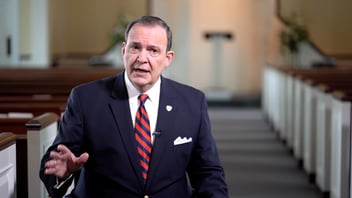
A person’s worldview is one of the most important things about them in the sense that it shapes their entire outlook on life.After I was teaching this class one week, a student came up to me, and she said, “I’ve got this idea for a book that you could write.” She described to me the very idea that I was already having. She described it in a different way, but the way that she was thinking about things was very much the way I was thinking about things. I took this as a providential prompting to try and conceive of a book that would allow someone to answer key questions, key worldview questions, and would help them understand and identify the worldview that they have. The way I presented it was in the form of a Choose Your Own Adventure book, or at least it was inspired by these Choose Your Own Adventure books that some people will remember from their childhood, where you don’t have a linear format that just tells a story, but actually you get to make choices. You get to make decisions about what path you follow through the story, and you end up with different endings depending on what decisions you make. Those books were very popular in my childhood, and I thought, “Well, you could create a book that’s an interactive book.” It’s not just that you read about these worldviews, but you get asked questions: Do you believe in objective truth or do you believe that truth is relative? Do you believe that there are real moral values? Do you believe that there is a God? If you do believe in God, do you believe that this God is a personal God? And so on. You can ask these questions and lead people through a path to a worldview, whether it’s a secular worldview or a religious worldview of some kind. Along the way, I could pose some gentle, critical questions about whether your worldview that you end up with really is coherent or whether it fits with the way that you’ve answered the questions or not. It’s meant to be primarily a tool for helping people to think about their worldviews, but also to gently lead them to consider the Christian worldview as an alternative to other worldviews and why the Christian worldview makes sense in a way that other worldviews don’t. Now, why should anyone care about worldviews? Why should we need a tool like this? My view is that a person’s worldview is one of the most important things about them in the sense that it shapes their entire outlook on life: what you believe about God, what you believe about the nature of the universe, the origins of the universe, what you believe about human nature, what kind of beings we are, why we’re here, where we’re going, what you believe about right and wrong. All of these aspects of a person’s worldview will shape not just the way they consider the big questions of life, but also their everyday living, the way they relate to other people, the way they think about their place in the world, their jobs, their relationships. Having someone think critically, carefully about their worldview I think is very important. But ultimately, we want a worldview that fits the world. We want the true worldview, the worldview that corresponds to reality as it really is, and my conviction is that that is the biblical Christian worldview. I want people to at least consider that and hopefully embrace that worldview. Holmes: Thank you. That’s very helpful. How we view the world has a profound effect on the Christian’s ability to faithfully engage the culture, which is our focus this week. Dr. Anderson, you answered this question in late 2019, how should Christians engage with the culture, via Wisdom Wednesday, which is our weekly Q&A series. Before we go any further, let’s take a moment and listen to Dr. Anderson’s response to the question: how should Christians engage with the culture? Anderson: How should Christians engage with the culture? Well, this is a very pressing question in our day. There’s a lot of discussion about it, and that is exactly why we’ve introduced a new course into our curriculum entitled Christ, Culture, and Contextualization, which is really devoted to giving an in-depth answer to that question of how Christians should engage with the culture. First, we need to start with the Bible. We need to start with a biblical theology of culture. Culture, in its simplest definition, is simply what we do with what God has made. It’s what human beings do with the created world, the natural world, and the resources that God has given us. The Bible, of course, has a lot to say about the world and what God has made and what we are to do with the world that God has made. So first of all, we want to start with Scripture, what Scripture gives us in terms of a biblical theology of culture.
Culture is a gift from God. It’s not something to be feared. It’s not something to be inherently opposed, but in fact, culture is part of the goodness of creation.Second, I think we want to recognize that culture is a gift from God. It’s not something to be feared. It’s not something to be inherently opposed, but in fact, culture is part of the goodness of creation. There is in Scripture what is called a cultural mandate for us to exercise dominion over the created world and to take the resources that God has given and use them for the glory of God and for the good of our neighbor. Thirdly, we need to recognize that culture is fallen. As well as a doctrine of creation, of course, Christianity has a doctrine of the fall, that this world is fallen in sin. Mankind is fallen in sin. Of course, that has an impact on culture. The culture around us is always going to be a mixture of good and bad. We need to exercise great discernment to be able to tell the difference between a God-honoring culture and a God-dishonoring culture. Fourth, I think we need to recognize that all culture is religious in nature because all culture reflects some sort of value system. So even a so-called secular culture—and we talk a lot about secular culture today—even a secular culture is in fact deeply religious at its root. There’s no such thing as a religiously neutral culture of any kind. Fifth, we need to recognize that we ourselves as Christians are part of the culture. We can’t separate ourselves from culture. We can’t isolate ourselves from culture. We are affected by the culture around us, and we also affect the culture around us, for better or for worse. Lastly, we need to view culture through the lens of the Great Commission. There are many things that we are called to do as Christians to serve God in this world. But the Great Commission, that great calling to take the good news of Christ to the nations, to make disciples of the nations, to bring the teaching of Christ to the nations, and to build up the church: that has to be a priority for us. The way that we relate to culture can help us in fulfilling the Great Commission, and in some ways it can hinder us as well. But I think that it’s important as Christians to recognize that the Great Commission is one of our priorities and is an important lens through which we think about our relationship to the culture around us.
There are as many ways to engage the culture as there are Christians.Holmes: So Dr. Anderson, give us a picture of what it looks like practically to engage the culture as Christians. Anderson: That’s a huge question, in a sense that’s the million dollar question, isn’t it? We talk about engaging the culture, and I don’t think anyone says we shouldn’t be engaging in the culture. But the question is: how do we go about that? What does that look like in practice? There’s a sense in which I can only answer that for myself, and each individual Christian can only answer that for themselves. There are as many ways to engage the culture as there are Christians. I’m a professor at a seminary, but there are people who are schoolteachers. There are Christians who are plumbers, who are realtors, and so forth.
The way that you engage the culture is by faithfully fulfilling your vocation.The way in which the individual Christian will engage the culture will depend on that person and the particular calling and giftings and opportunities that God has given them. In a sense, the way that you engage the culture is by faithfully fulfilling your vocation. Whatever it is that God has called you to do, you are to do that faithfully as a servant of Christ, living out the likeness of Christ in that role and seeking to serve others and to serve the public good. So in a practical sense, you just have to ask, “Where has the Lord placed me? What is it that I am able to do? What are the good works the Lord has called me to do?” And then do them with all your heart to the glory of God. In a general sense, we can think about engaging the culture in terms of understanding the culture. We as Christians want to be aware of what is going on around us in our local neighborhoods, in our cities or towns, in the world. The first step in engaging the culture is to know what is going on in the culture, to understand it. That requires watching the news, maybe reading some good magazines, some good sources to understand what is going on around us, and what are some of the cultural movements that we are in the middle of.
The first step in engaging the culture is to know what is going on in the culture, to understand it.Then the task is to evaluate, to exercise discernment, to ask, “What is good? What is bad? What should we be conserving in the culture? What should we be protecting and what should we be opposing? What should we be criticizing in the culture?” Evaluation, discernment is part of that task. Once we have a sense of that, we ask, “How should we be responding? How should we be acting in response?” Sometimes that means speaking. Sometimes that means witnessing to the truth, saying, “This is false, and this is what God’s Word says is the truth.” Sometimes that means doing things: good works, trying to address injustices, trying to address needs or suffering in the world that we see. Sometimes it just means being a faithful Christian witness, living out the likeness of Christ in grace and love and service towards others. Another aspect, of course, is creating culture. It’s not as though we as Christians expect nonbelievers to create cultural things, and then we come in and say, “Hey, that’s good, that’s bad. What will we do with this?” I think that Christians should be encouraged to be culture makers, to be cultural creatives, to do new things with what God has provided to us, whether those are works of art or works of literature or works of technology, scientific innovation. My hope is that one of the major ways that we influence the culture is being at the forefront of creativity and innovation, inventiveness, putting what we have to good use to advance knowledge, to advance understanding, to advance the public good in the general sense.
Christians should be encouraged to be culture makers, to be cultural creatives, to do new things with what God has provided to us.Holmes: That’s helpful. So what would you say is the relationship between loving your neighbor and faithfully engaging the culture? Anderson: That’s a great question. The relationship between loving our neighbor and faithfully engaging the culture. Well, I don’t think they’re the same thing, but clearly they can’t be separated. On the one hand, of course, we are called to love our neighbor. One of the ways that we love our neighbor is being engaged with the culture. So, for example, if we look at the culture, and we see that there are things in the culture that are wrong or unjust or are causing harm or suffering for people, then to address that is to love our neighbor, to provide a better culture that will be for everyone’s benefit. Conversely, as we think about engaging the culture, there’s always a danger that we depersonalize the culture. We see the culture as this abstract thing, and it’s our job to either affirm it or to oppose it, forgetting that the most important element of culture is the people around us. Maybe one way to think about this is in terms of the so-called “culture wars.” Christians talk a lot about the culture wars and fighting the culture wars. There’s a sense in which there is a war. I prefer to see it more in terms of a spiritual battle that we’re engaged in, not against people, but against unbelief and against the spiritual forces that we’re called to combat. But the problem with the culture wars is that there’s a lot of casualties. There can be Christian casualties, and there can be non-Christian casualties. And some Christians, I think, see it in terms of Christians versus the world, Christians against unbelievers. The unbelievers are doing the bad things, and Christians especially are doing good things. When in fact, it’s much more complex than that. There are Christians who are doing some good things. There are also some Christians who are doing things that are not good in the general sense. Likewise, there are unbelievers who are doing positive things in the world; there are unbelievers who are not. Part of our task is to ask whether the way in which we are engaging the culture really is serving our neighbor. Is it just promoting a cause or is it actually serving the public good? Serving what is good, not just for Christians, but for human beings in general who are made in the image of God? If we really want to love our neighbor, then the first thing we want to do is proclaim the gospel because that is what people need more than anything else. They need to know the love of God revealed in Christ and the only way of salvation, the only way of atonement for our sins. Loving our neighbor by engaging culture will mean, first and foremost, faithfully proclaiming the gospel and living out the implications of the gospel.
Loving our neighbor by engaging culture will mean, first and foremost, faithfully proclaiming the gospel and living out the implications of the gospel.It’s also going to mean pursuing biblical justice, justice not in worldly terms, but justice as the Bible defines justice because that kind of justice is good for people. The way that God has ordered the world, or the way the world should be ordered according to God’s laws, is in fact good for people. It will lead to that blessing, it will lead to that prosperity, it will lead to their flourishing. We want to pursue that. Then maybe thirdly, we love our neighbor simply by serving them, by saying, “What can I do for you today?” That sometimes requires sacrifices. If I’m going to do something for my neighbor today, that probably means I’m not going to do something for myself. I’m going to have to give up something. I may have to do something that makes me uncomfortable or costs me something. This is the way of Christian love: to look for our neighbors’ needs and ask, “What can I do to serve you today?” That’s going to be engaging the culture because we’re going to be serving as salt and light. We’re going to be bringing the aroma of Christ to the culture around us, and it’s going to be loving our neighbor in a very direct, tangible, practical way. Holmes: That’s good. Thank you, Dr. Anderson, so much for joining us today. That was really helpful in helping us to think through culture. This is a very hot topic right now. I want to specifically bring you back at some point to talk about worldview and to sort of tie these two things together. Because as I mentioned earlier, our worldview has a huge effect on our ability to be faithful as we engage the culture. Because if we don’t have a strong Christian worldview at the foundation, we can easily be misled and oftentimes even confused and confuse others as well when we’re trying to discern what is Christian, what is biblical, and what is unbiblical. So thank you, Dr. Anderson, for joining us today. We appreciate you taking time out to talk with me. Anderson: God bless. Holmes: Thank you for tuning in, and we hope you enjoyed this week’s episode with Dr. James Anderson. I would also like to thank the RTS family, church partners, students, alumni, and donors for the many ways you make the work of Reformed Theological Seminary possible. The clip we listened to earlier is from our weekly video series Wisdom Wednesday, where relevant matters of the Christian faith are addressed by RTS faculty and friends with true, candor, and grace. Access our entire archive or submit a question at rts.edu/wisdom-wednesday. Mind + Heart is powered by Reformed Theological Seminary, where we desire to raise up pastors and other church leaders with a mind for truth and a heart for God. Thank you.