Those tend to be the most effective men in ministry: the ones who are not pretending.I have generally found that people resonate with people. The values that we have as pastors, as instructors, or even as parents to our children or even as older brothers of the Lord or siblings who are fellowshipping with those who are under us, it’s those things that transfers through to those. It’s such a natural, organic thing. You don’t have to tell them to necessarily love Hebrew or love the Bible. They get it from you. A pastor, who, let’s say, reads the Bible consistently every year, that’s going to rub off. His congregation is going to do the same exact thing. I’d like to think Hebrew or Greek or Old Testament or Reformed theology or whatever it is that we teach can be embraced by our students in the same way. Holmes: Yeah, that’s so good. I would imagine that clarity plays a huge factor in it as well. In marketing, we talk about how important it is for marketers to be clear. That’s really our job in a lot of ways because people engage what they can understand. There has to be an ability to take something that many view, not just as boring but also as complex and foreign, and your ability to make it accessible, to make it clear, I’m sure also plays a huge factor in students’ willingness to engage. Then your excitement about it is sort of the icing on the cake as well, because if you were not clear but were excited, they would just say, “I mean, I’m glad he’s happy, but I don’t understand what he’s so happy about.” So you have to be clear as well. Lee: That’s absolutely true. Perhaps that’s one of the errors of overzealous seminary students. They graduate and before you know it, they’re just assaulting their people infralapsarianism or the divine decrees, and they don’t know what in the world is going on before them. “But hey, he’s happy up there, so I’m happy for him.” It’s true. The Lord has blessed our seminary for that reason, with really great teachers of the languages. The languages in the seminary curriculum, as you know, tend to be the more challenging subjects because people don’t come to seminary wanting to study Greek and Hebrew. They want to study theology, Bible, and the language they do because they have to do it. It’s already at a motivational standpoint against us. To be able to have that and to have men who are gifted, who can teach this is great. Plus the fact that the Lord has really blessed the seminary with men who are, at least in Hebrew, that are writing great grammars. Mark Futato has a great grammar that is very user-friendly. Miles Van Pelt has a Hebrew Grammar. Bill Fullilove has a Hebrew grammar. These are great tools that really take what looks like a challenging language like biblical Hebrew and really make it very user-friendly. In fact, so user-friendly, you can just pick up any of these grammars and read it on your own. You don’t even need me, necessarily. Holmes: That’s good. As you know, this week’s episode is entitled “Joy.” In 2019, Dr. Lee answered the question, “How do I find joy in suffering?” via Wisdom Wednesday, our weekly Q&A video series. I wanted to bring you back, Dr. Lee, to elaborate more specifically on joy. But before we do that, I want to provide our listeners with some background on your relationship with the topic. You’ve written a book entitled Joy Unspeakable. Talk to us briefly about why joy is such a major theme in your life. Lee: Thank you, Phillip. I appreciate the question. Joy, particularly joy in the midst of suffering, has been an important thought that I’ve had in many ways because I, like so many other people, like believers and Christians out there and even non-Christians, I have had rough times in life. They’ve been very challenging. Once you get by one difficult time of life, you think it’s over, and it isn’t. You run into another one. We really are going through rough times, as you know, in so many different areas of the church and individuals in the last six months or so. There was a particular time when I was very young, I was a young seminary student, and I went through a particular challenging time, and I just needed clarity. I just needed some thought. I just needed some some time to reflect and healing. I decided to kind of get away and go to well, of all places, I went to seminary. I went to my seminary, and there was a one-week intensive class that was being offered at the time that was taught by Dr. Edmund P. Clowney. Dr. Clowney is a legend in Reformed circles and in his commitment to preaching Christ in all of the Scriptures. The class that he was teaching at the time was Preaching Christ in 1 Peter. That class just was so helpful in just bringing real clarity and really bringing some very thoughtful challenges for me from the Word of God. Really, ever since then, I have really contemplated the idea of joy in the midst of suffering. Some of it was very influenced by that week intensive in the epistle of 1 Peter. The theme of 1 Peter in many ways is exactly that. He is writing to an audience that is going through significant trials and hardships because of their professing their faith in Christ. Peter wants to give to them a hope, a hope that he describes as a living hope, which is such a fantastic phrase. He also assures them that they can have an inexpressible joy, full of grace and truth, in chapter 1 in verse 8. But he talks about it not as an inexpressible joy that is only in the future, but he talks about a joy that you can have right now, even in the midst of the trials you’re going through. That idea of joy in the midst of trials, not just any joy, but again, this inexpressible joy. The old King James has a great translation, and I’ve always been so taken aback by it that I used that as a title for the book, “a joy unspeakable.” An indescribable joy, a joy that’s a product of heaven, a supernatural joy that can only be found in Christ, and for that reason, not a product of this world. Believers can have this now, not just in the future, but can have a taste of it now. The book really is dealing with trials and hardships, but I didn’t want to deal with trials and hardships. I wanted to deal with the joy that we get from the hardships. That’s the reason why I chose the title that I did as a way to encourage God’s people to realize, “Hey, look, you’re going through hardships. I get it. I was there. I’m still there to a certain degree, and we’re not alone. But this doesn’t have to defeat you. This doesn’t have to destroy you. In fact, it can be the radical opposite. Guess what? The Bible says that you can have not just any joy, but an unspeakable joy, an indescribable joy. That’s fantastic. And you can have it right now as you cling on to Christ.”
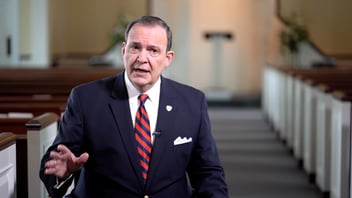
How much do we really want to know Jesus?I really wanted to pursue that more. I’ve been on this sort of quest throughout not just my personal life but even my pastoral life. To do so, I preached through 1 Peter. In my church plant, the first book that I preached there was 1 Peter. I really tried to pursue that idea of what Peter refers to as righteous suffering that produces joy. I bring it in in a few places within my lectures as well, really applying some of the principles of 1 Peter and taking them and applying it throughout the history of salvation to show that there are examples of this in the Old Testament as well as in our life today. That really was sort of the stimulus behind the book. I wanted my first significant publication to be something that was going to be helpful and encouraging to God’s people. Holmes: That’s super helpful. Thank you for sharing that. So before we go any further, let’s take a moment and listen to Dr. Lee’s response to the question: how do I find joy in suffering? Lee: In 1 Peter 4:12–13, the Apostle Peter tells us, “Don’t be surprised by the fire ordeal that you’re going through as if something strange is happening to you.” And then he goes on to say, “but to rejoice because you share in the sufferings of Christ.” He first tells us, “Don’t be surprised as if something strange is happening to you” because nothing strange is happening to you. We are called to expect this. There’s nothing wrong with you, there’s nothing wrong with your faith, and perhaps more importantly, there’s nothing wrong with God. But then he tells us to rejoice, and he tells us, ironically, to rejoice really because we share in the sufferings of Christ. Now, that’s not perhaps the way that we would normally think through this. We don’t normally think of joy connected with suffering. How is suffering going to bring joy? You see, Peter doesn’t talk about suffering in general. He talks about suffering with Jesus, sharing in Jesus’s suffering as the source of joy. See, the question I think we need to wrestle with is this, folks: how much do we really want to know Jesus? If you think about it, I dare say that what we think about is we really want to know the glory of Christ. That is, to be justified in Christ, to be sanctified in Christ, to be adopted in Christ, to be glorified with Christ. We think of the great blessings that we have in Jesus, and that’s what we want to know. But when we think about the suffering of Jesus, that’s something that doesn’t really catch us as something terribly exciting.
If you have one, that is his glory, without the other, that is his suffering, then you never really will know Jesus.You want to know something? If you have one, that is his glory, without the other, that is his suffering, then you never really will know Jesus. And isn’t that the joy of the Christian, to really know Jesus? That’s what the Apostle Peter here is really stressing. It’s not suffering that he wants us to know, but it’s the suffering of Christ that he wants us to know. It’s not just hardship and pain that he wants us to know. It is the hardship and pain of Christ that he wants us to know because only by knowing Jesus holistically, completely in his suffering and his glory, only then will we know the whole Christ. In that sense, only then can we truly have a joy unspeakable. You take away the Christ-like pain, and you take away the Christian’s joy because they will never really understand and know Jesus. Holmes: So, Dr. Lee, would you mind giving our listeners a working definition for joy. What is joy? Lee: Yeah, I guess I would define joy as not just an emotional sense of experience, but a sense of contentment, peace, and satisfaction that transcends all scenarios, situations, circumstances that can only be found in Christ. In other words, you can go through a horrible scenario, a horrible situation in your life. And guess what? You can still have a sense of contentment and peace in spite of what you’re going through. But this joy can only be really found by faith in Christ. It’s a very theo-centric, christo-centric reality. And for that reason, I would say it’s something that’s really exclusive only for believers. Only a true Christian can experience this kind of joy. Holmes: That’s super helpful. Right now we’re in the middle of a pandemic. There has been a lot of loneliness, I’m sure a lot of depression. We also know that there are many people who have suffered loss, whether it’s job loss or the loss of a loved one. In the midst of a time like this that can be potentially devastating as Christians because a lot of Christians are also more disconnected from the body than they’ve ever been. If you’re single, I would imagine that pursuing friendships and a lot of those things can be hard. And sometimes, even in the family, like you talked briefly before we recorded about how much time you’ve been able to spend with your family and how much of a joy that that’s been. I can attest to the same thing. But there are many who are spending more time with their families, and they haven’t had necessarily the same experience. What would you say to someone who was in the middle of suffering, struggle, experiencing loss, sadness, depression? How would you encourage them to pursue and fight for joy on the day-to-day basis? Lee: It’s such a great question. It’s questions like that that really motivated me to write a book like that. You’ve mentioned so many wide-ranging type of scenarios that we face now. Maybe the way I’d want to begin is, it may help us first to understand what’s causing the struggles and the trials that we’re going through. We live in a sinful world. We are sinners. We are totally depraved and are in desperate need of the grace of God. When we sin, it will bring hardship. It’s just the nature of sin. Sometimes it just takes some real deep wisdom to be able to be humble enough to acknowledge when we have wronged the Lord and and then repent of it. I mean, it’s a bit simplistic, but the ultimate biblical solution to the sins that we commit that causes harm is just simple biblical repentance.
Sometimes it’s because we cling on to Christ that we will suffer.A lot of the trials that you mentioned, though, are not like that. They are things that we endure through in spite of the fact that we are being obedient. We’re fighting to cling on to God. We are trying to live our Christian lives as best as we are able. And yet, in spite of that, we will suffer. Sometimes that suffering is excruciating. Sometimes it’s because we cling on to Christ that we will suffer. That’s sort of the oddity. That’s such a weird disconnect. It’s sort of like the book of Job, where Job was under tremendous hardship because he stood out as a righteous man who clung on to the Lord. I always found that so ironic. If Job was just your average schmoe who just lived his own selfish life, nothing would have happened to him. It was really the Lord who pointed him out to the Satan figure, “Hey, if you know this Job here, I mean, look at him. He’s outstanding.” Had God not even done that, Job would have been fine. There’s a lot of trials that we go through that are times like that. That’s harder. There’s nothing to repent of. There’s no sin you’ve committed. You didn’t do anything or think anything to cause your hardship, but you’re suffering nonetheless. You mentioned the loneliness that we go through because of the pandemic. We didn’t ask for this. We didn’t want this. We didn’t ask for the churches to be shut down and to be isolated as individuals. It’s just the trials that we have to endure through right now. We want to celebrate the Lord’s Supper, but for a while we couldn’t do that and we were withheld the element and isolated and alone. Does the Word of God have a word of comfort for people who are going through this? Well, yes, it actually has a lot to say about trials and hardships like this. In the first opening chapter I just survey, as exhaustively as I can, all the ways that the Word of God brings words of comfort to trials like this, not because you sinned against God. You’re doing as best as you are able. You’re living your life. Surprisingly, the Bible has a lot to say about that. It’s kind of hard for us as Calvinists perhaps to grasp this. We are so fixated on the total depravity of man and thus the need to repent. And we forget that there’s so much of Scripture that deals with Joseph in the book of Genesis or the book of Job or lament Psalms, that is the innocence of the Psalmist but yet he cries out to God. We know the church of Acts in the book of Acts that is preaching the gospel, and they’re being arrested, persecuted, whipped. Don’t forget that there’s actually a lot of Scripture that deals with this more righteous kind of suffering. That is a trickier thing to know how to repent. What’s encouraging for me is what 1 Peter 4 says, and this is the way that I try to encourage people to really find joy in the midst of these kind of righteous suffering types of trials. You know, if you sin, repent. It’s simplistic, but that’s essentially what the Bible says. But if you are suffering for righteousness’s sake, as 1 Peter says, then what do you do? Because there’s nothing to do. You’re doing all the right things. So what do you do? And what Peter instructs us there, he says in 1 Peter 4:12–13 to not be surprised by the trials that you’re going through as though something strange is happening to you. First of all, that’s great. What you’re going through is not weird. There’s nothing wrong with you. There’s nothing wrong with your faith. There’s nothing wrong with God. Perhaps that’s the most important thing. But what you’re going through is to be expected. And then he says, “but rejoice because” the phrase he uses is “because you fellowship with Christ in his sufferings.” It’s that phrase all the way back to my Ed Clowney class period that just sort of captured my mind. This koinonia, this intimacy that we have is with Christ, but in his sufferings? That made no sense to me. What the world could that mean and how is that a source of joy? I would think he would say suffer with the glorious Christ, the resurrected Christ. But he doesn’t say that. It’s to fellowship with Christ in his suffering.
I think we forget that the first innocent sufferer or the ultimate innocent sufferer is Jesus himself.I think we forget that the first innocent sufferer or the ultimate innocent sufferer is Jesus himself, the ultimate epitome of the one who did everything right, perfectly obedient in ways that we never have been or will be. And as a result of that, guess what? He suffered badly and suffered righteously. This righteous suffering that we endure through is almost the Bible’s way or Jesus’s way, perhaps, it’s an open invitation for us to come to know me in the wholeness of who I am and what I experience. Did Jesus experience glory? Oh absolutely he did: the resurrection, the ascension to the right hand of the Father, his ultimate victory over Satan. He absolutely experienced glory. But as you know, the Scripture talks about Jesus as that suffering servant. I guess the question is: just how badly do we want to know Jesus? How much do we really want to say we can identify with Christ. We want the glory, but guess what? To know Christ is to know his suffering and his glory. If you only know his glory and not his suffering, you don’t really know Jesus. The joy that we can find, therefore, is knowing the full and the whole Jesus. That means that you have to know his suffering as well as his glory. Do you know loneliness? Yeah, you do. But guess what? Jesus knew it even more intensely, and now you can fellowship with Christ in that struggle. I think we have to define joy not as a subjective experience, but an objective reality. Joy is defined by how well you know Christ. It has nothing to do with whether you win the lotto or not. It has nothing to do with whether your church is growing. Well, maybe mildly. It really has nothing to do even with your health. You could be dying of cancer, and guess what? You can still find joy in Christ because we share in his sufferings as well as his glory. It’s that call to redeem the suffering. Not just think, “Suffering is bad now, glory is good later.” Peter sort of redefines the parameters there. He says suffering is good. Now, yes, glory is better, but suffering is good if it is in Christ.
Joy is defined by how well you know Christ.That’s why we can identify with Joseph, let’s say, in the book of Genesis, because that is a picture of Christ, and we are called to fellowship with Christ there. We can identify with Job because that’s a picture of Christ, and we now can fellowship with Job and with Jesus Christ. It’s redeeming the suffering to see that this is fellowship with Christ and therefore our joy is in knowing the holistic Jesus, the full Jesus, that I find is just so liberating and so compelling. You don’t need your circumstances to change. Our joy is in our identity in Christ, in his suffering and glory. As you know, Phillip, in the last six months or so, with all the racial injustice, the attempt has been made for non-African Americans like myself to empathize with the plight of the African community. To some extent that we can do that brings us to a greater sense of unity and fellowship. Now, never, ever to the same extent that our African American brothers and sisters are enduring through, but the call is there to identify and sympathize. It’s a similar type thing, but the reality is that this is a greater sense of unity. A union with Christ by the forging work of the Spirit of God that helps us to fellowship with Christ in his sufferings and his glory, where joy is defined by that union in Christ, in his suffering and glory. The objectivity of joy is what I find so compelling and liberating and just relieving for myself as well as for others who are enduring the same kind of trial. Sorry, I know that was sort of long-winded. Holmes: No, that was super helpful. And I appreciate you taking time and thinking through all the different aspects and situations and how this applies to various things that are going on in our society right now. There’s a lot of angst. There’s a lot of fear, some real and I think some of it is also being flamed in a lot of ways by the media. But there are a lot of real concerns as well that are taking place in our country. As Christians, we can’t lose hope and we have to fight for joy. So I appreciate you giving pastoral concern to this particular issue and this topic, because I think a lot of people are looking for answers and hopefully they’re finding them in their local churches as well. But we also hope that we can come alongside local churches and reemphasize what they are already teaching and encouraging their people to do on a day-to day-basis. Lee: Absolutely. I’d encourage people to read my book if that’s available. But just read 1 Peter, just sit down and read it. It’s five chapters, you can do that in about 10 minutes, not even 10 minutes, really. Just sort of let the Word of God speak to you, and it’s just hugely helpful. Holmes: Amen. Thank you for tuning in, and we hope you’ve enjoyed this week’s episode, featuring Dr. Peter Lee. We thank you for joining us today. I would also like to thank the RTS family, church partners, students, alumni, and donors for the many ways you make the work of Reformed Theological Seminary possible. The clip we listened to earlier is from our weekly video series Wisdom Wednesday, where relevant matters of the Christian faith are addressed by RTS faculty and friends with truth, candor, and grace. Access our entire archive or submit a question at rts.edu/wisdom-wednesday. Mind + Heart is powered by Reformed Theological Seminary, where we desire to raise up pastors and other church leaders with a mind for truth and a heart for God.