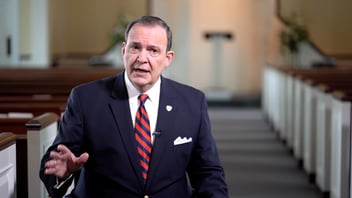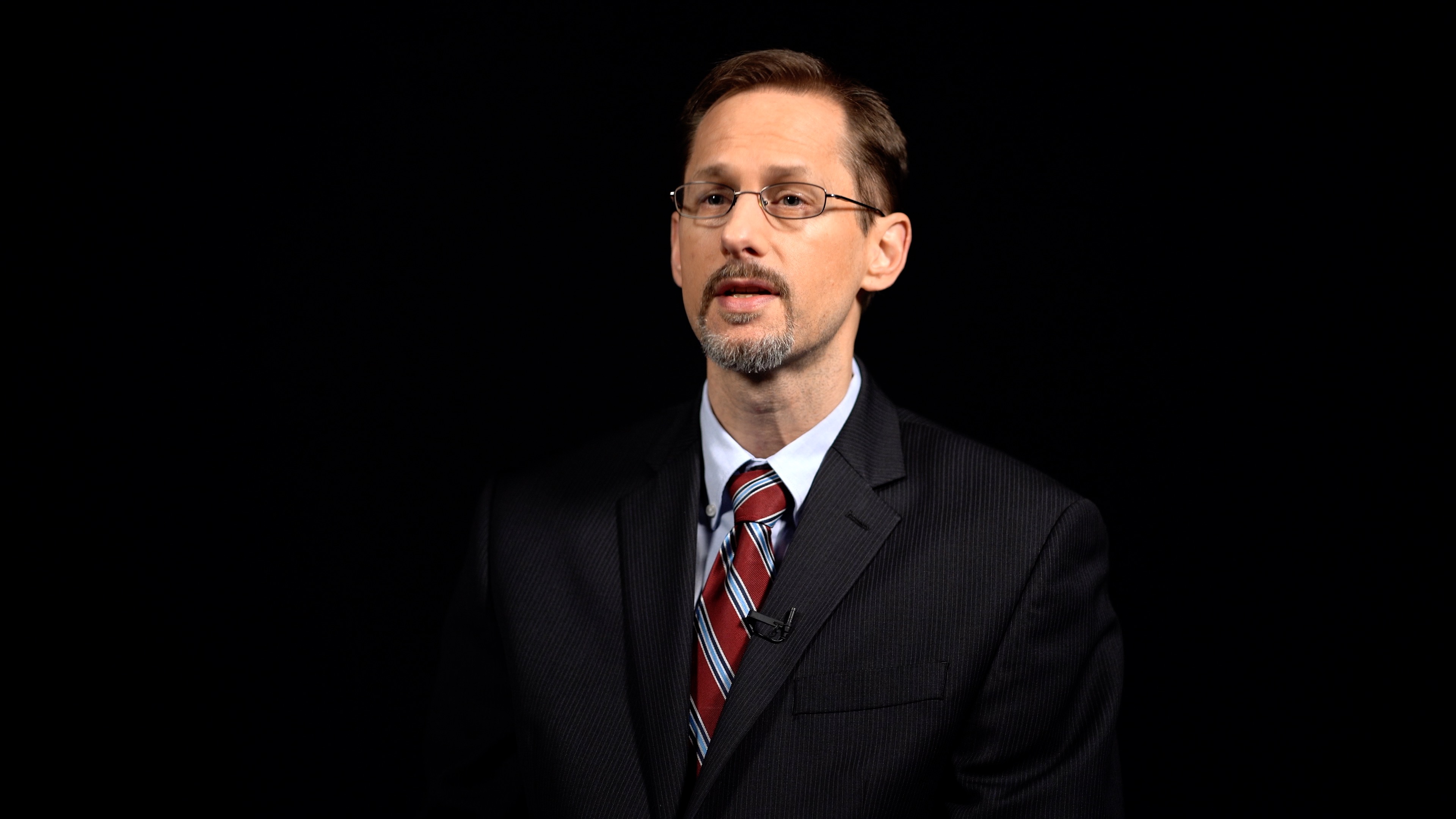
Forgiveness is a huge part of any relationship, but especially one as intimate as marriage.Richard: No, actually, never. [laughs] Unfortunately, I’ve been in my fair share. I’ve been married for 27 years, so that certainly qualifies. I tell people my wife and I have a very similar personality and so we butt heads. We wear our emotions on our sleeve. We are “what you see is what you get” kind of people. When you’re both that way, I never have to wonder, “Where’s my wife and what does she feel about this?” Because she tells me right off. I don’t need to wonder, “Am I in trouble? Am I in the doghouse?” Because I know when I’m in the doghouse and vice versa. Yeah, no doubt I have plenty of disagreements. I think the first fight I had with my wife was on our honeymoon, of all times and all places. Silliest of issues, but that’s the way it is. We fight and we argue, but no doubt a need for forgiveness is a huge part of any relationship, but especially one as intimate as marriage. Holmes: Amen. Amen. So before we go any further, let’s take a moment and listen to Dr. Richard’s response to the question: “Must I forgive someone who doesn’t ask for forgiveness?” Richard: One of the things I remember most about growing up is something my mom used to tell me, and she’d tell me, “Guy, it takes two to fight.” And that is true. It takes two people to disagree. It takes two people to have a fight. Likewise, it takes two to make up. It takes two to reconcile. So in one sense, if we’re looking at two people who have fought together—there’s some kind of division between two people—there needs to be two people involved, both sides need to be involved in reconciling.
Both sides have to want that reconciliation to happen before there can be true reconciliation.So in answering the question about whether or not we must forgive someone who has not apologized to us, in one sense, we can answer that question by saying no, because that person, in order for real restoration or real reconciliation to happen, that apology must happen. Both sides have to want that reconciliation to happen before there can be true reconciliation. The other side of that is we don’t want to harbor bitterness, and we don’t want to harbor anger, even when someone doesn’t ask for our forgiveness or doesn’t come and apologize for whatever it is they’ve done to us to offend us. Even in those situations, when someone has offended us, we need to still forgive in a sense. We may not have true reconciliation because both sides are not involved, have not bought into that reconciliation process, but we need to be able to let it go. We need to be able to let that offense go so that it doesn’t eat us up alive, so that that bitterness and that anger and that frustration doesn’t just consume us. A great example of that might be something that’s very mundane and very much a part of our lives. When we’re driving in traffic—something that I know very well here in Atlanta—and someone cuts us off, we’re liable to say a few choice words and we get angry, because this person violated us. They cut us off in traffic. And yet rather than letting that go, we oftentimes allow that to stay with us and that anger can eat us up. We carry that anger into the office, and we come in and we’re in a bad mood for the rest of the day because we’ve not let that go. That person hasn’t apologized. There can’t be reconciliation in that sense, but there can be forgiveness in the sense that I let what this person has done go. I don’t let it affect the way that I live the rest of my life. I don’t let it affect the way I see even that person. I don’t let it affect the way I interact with others.
We must never hold on to the wrongs that someone has committed against us.We must never hold on to the wrongs that someone has committed against us and, rather, be willing to give those over to the Lord. The Lord says that vengeance is his and he will repay. Each one of us needs to be able to give over whatever has happened in our lives to the Lord and let him make right of all wrongs in our life. Holmes: Dr. Richard, on YouTube, where this video is posted, we had one commenter who disagreed with what you said in the video. But he had a fairly unique situation that I wanted to give you some time to address. I won’t read the comment in detail because it’s fairly long. But essentially, the first part of it is that he says, “I’m sorry I must disagree, but anyone who has ever been a victim of a psychopath knows that division doesn’t always come from dissension between two people.” He’s addressing a particular type of situation, and I don’t think that you were speaking generally on that. I’ll let you respond to that. He elaborates to talk about his experiences. He says, “And maybe I bring a curdled perspective to this.” There’s that. He says, “I’ve been severely disabled since age seven, when I was almost killed in a mass murder. And throughout my life since, I’ve been lied about, on several occasions, by at least three people who didn’t know of one another’s existence, all in an effort to deny me income above the level of the most wretched poverty. No one needs adequate income quite as much as a severely disabled person.” And he says, “You’re never quite the same after you learn that a federal administrative law judge has lied to your face.” He goes on and unpacks that a little bit more. Dr. Richard, you’ve read the comment in full. How would you respond to his comment regarding your video? Richard: Well, the first thing I would say is that I’m certainly sorry to hear of the difficulties that this individual has been through. Why in the Lord’s providence hardship and difficulty occur in our lives is something that we can’t always readily answer. Some of us face greater difficulties. If we put them on an objective scale, somehow a continuum, if we could do that and be objective in our ranking and evaluating, some people, we might say, get more than “their fair share” of hardship or difficulty. Why that happens, ultimately we don’t know. We just have to trust the Lord and his wise providence that he knows best for each of us. The longer I’ve lived as a Christian, the more that I’ve come to realize that all of us have difficulty and pain and hardship. That difficulty and pain and hardship takes different expressions and forms in each of our lives, but it’s equally severe. Someone who is going through something like what this individual has gone through might look at what I’ve been through and say it’s nothing. He might wish he had what I had, but God knows us. He knows us better than we know ourselves. He knows our strengths and our weaknesses. He knows our frame because he has made us as we are. He gives to each of us, I am convinced, a set of hardships and difficulties. He allows them, whatever term we want to use there. He is sovereign over them, and he fits them to our form and to our frame so that they are hard for us. We can’t look across and see what somebody else is going through. So the first thing I would say is, no doubt, I’m sorry to hear about this person’s struggle. That’s a hard situation.
Why in the Lord’s providence hardship and difficulty occur in our lives is something that we can’t always readily answer.The second thing I would say is that my comments did address exactly what this individual was going through in this situation of a psychopath. There may not be a break in a relationship because it’s a psychopath. If that’s the case, there’s no reconciliation needed. So forgiveness in a biblical sense, which always is unto reconciliation, need not apply. But the second item which I talked about in terms of letting things go, that aspect of forgiveness, which we can get into more as we go through today’s podcast, but that, in terms of letting what this psychopath did go. This individual, as difficult as this is, he or she needs to be able to let this go and not harbor bitterness, give it over to the Lord and trust the Lord in his providence for this difficult, this hard providence. Give it to him and trust that the Lord will bring even this wrong to right, either in space and time in his lifetime or her lifetime or when Jesus returns. But at some point, all wrongs will be made right, and to be able to forgive in that sense, in terms of giving it over, still applies in this situation as well. Holmes: That’s extremely helpful. I want you to define forgiveness because I think there may be a breakdown there. You talk about forgiveness unto reconciliation, but then you also make a distinction of forgiveness that happens similar to this person’s case, a one-way transaction where the other person is not pursuing reconciliation at all. The other person also isn’t necessarily pursuing reconciliation, but they don’t want to harbor bitterness. Make sure we have a healthy and a biblical understanding of forgiveness. Richard: That’s good. That’s good, Phillip. I would say biblically speaking, forgiveness is unto reconciliation. Reconciliation, which is what God has done with us, is impossible without forgiveness. Forgiveness is not an end to itself, but forgiveness is always, in the Bible, in terms of God’s action with us, forgiveness is always unto the end. It’s a means, if you will, unto the end of reconciliation. God has reconciled the world, he has reconciled us to himself in Christ. So the forgiveness through Christ, being pardoned of our sins, being set free from the punishment, and God not holding us to account for our sins because he held Christ to account for those sins is unto relationship repair. It’s unto bringing us together with the God of the universe in terms of relationship. When we look at forgiveness in general, I would define it, I think, as simply as I could. I would define it in terms that the Bible uses. The Bible on a number of occasions uses the language of Jeremiah 31. I think it’s in Hebrews 8, and I think it’s in Hebrews 10. I know it’s in two locations at least in the book of Hebrews, where the apostle talks about the Lord remembering our sins no more. If I had to put one biblical verse, if you will, one Bible passage on what it means to forgive, it would be that passage, that idea that God, because of Christ, for the sake of Christ and what Jesus has done, remembers our sin no more.
Biblically speaking, forgiveness is unto reconciliation.I think it’s helpful to begin looking at what that means. It certainly doesn’t mean that God deletes from his memory banks the actual factual knowledge of what has transpired. God doesn’t forget in that sense. He still remembers. He is omniscient. He knows all. He doesn’t subtract out of his memory banks any data that was there beforehand. No. When he says, “I will remember your sins no more,” he doesn’t mean that he’ll forget that they happened, he’ll forget that we did them. He means he will not treat us in light of those sins. He will not hold them against us in that the way he will now respond to us will be in light of those things. We can think about that. We do that, don’t we? That’s where we struggle oftentimes in marriage or in a relationship. My wife violates me, and what do I want to do? I want to respond in kind. I want to hold what she has done against her, and I want to respond in light of what she has done. It’s hard for me in that sense to remember her sins no more. Not in the sense that I forget she committed them, but in the sense that I choose to respond to her with my words and with my actions and even with my thoughts in a way that I will not take into consideration the sin she has perpetrated against me. That’s a biblical pattern for forgiveness in terms of God remembering our sins no more. That’s exactly what we see, this idea of reconciliation and forgiveness going together. We see it in the way God forgives us: he remembers our sins no more. That forgetfulness, if we can put it that way, defined in the way we’ve defined it, is unto reconciliation, is unto a repair of the relationship. Certainly that’s the goal in marriage too. When I forgive my wife, that forgiveness, that remembering her sins no more, is unto repairing the relationship. The relationship is of paramount importance. I think that’s the whole context we see in Matthew 18, too, with the parable of the unforgiving servant. If you remember that parable where Peter comes to ask Jesus, “Jesus, a man sins against me 7 times. Do I forgive him?” And Jesus says, “Not just 7 times, but 70 x 7 times.” He then goes on and tells the story of the king and all the rest and the unforgiving servant. But if you back up a few verses before Jesus tells that, before Peter asks that question, Jesus is speaking and he says, “If your brother sins against you, go and tell him his fault between you and him alone. If he listens, you’ve gained your brother. If he does not listen, take one or two others.” On and on until he tells says, “Take it to the church.” The whole point here is Jesus is talking about reconciliation, and in light of the reconciliation and repentance and making sure that we’re apologizing, that we’re dealing with offenses between brothers and sisters. It’s in that context that then Peter asks the question and Jesus answers with the parable of the unforgiving servant. When he’s talking about the obligation we have, if you will, or the motivation we have, the duty we have, all of the above to forgive that is coming in the context of being unto reconciliation, as Jesus makes clear here in Matthew 18. Holmes: That was so helpful. I don’t know if I can remember that distinction ever being made in regards to how we understand forgiveness. That sheds so much light on your video. I wasn’t going to say this, but I’m happy to eat humble pie now. Even to me and how I’ve thought about forgiveness—and I have some seminary under my belt, I work at a seminary, I have biblical studies degree, I’ve been in the church my whole life. So I don’t feel embarrassed because I think we use those words interchangeably sometimes. So my assumption was that you were the one who was using reconciliation and forgiveness interchangeably. As I’ve scanned passages, I think you’re right. It seems that forgiveness is always mentioned in the context of two people where reconciliation is possible. But specifically when he’s talking about our enemies, to my knowledge, the Bible never says, “Forgive your enemies.” The Bible says, “Love your enemies.” Richard: That’s right. Love your enemy, pray for your enemy, do good, bless them when they curse you. So it speaks in that sense of blessing and of praying for and doing good unto and you turn the other cheek and you go the extra mile, all of that, but it never says to forgive. The idea of forgiveness seems to be always connected with reconciliation and a restoration of relationship. I do think, based on the passage you brought up, loving your enemy, that’s the basis from which I get the second part that I mentioned because the Bible does call us to bless those who curse us. When the person cuts us off in traffic, we’re not to respond in kind. Even though there can’t be reconciliation because there may be no relationship there at all anyway to be broken, but there is a sense in which I need to forgive in the sense that I need to bless and not curse in turn. In the sense that I need to pray for and to do good unto and to love my enemy and not allow what they’ve done to me to then affect me and drive my attitude and heart and embitter me and all the rest of it.
The idea of forgiveness seems to be always connected with reconciliation and a restoration of relationship.Holmes: So good. We can end the podcast, we can end this episode right there because I think that’s enough for people to chew on. I’m going to ask you one more question. What is the first step to forgiveness? Just to give people something practical to work with. Now we understand forgiveness is unto, from a biblical sense, reconciliation. We’re not talking about an enemy, someone who has no desire to reconcile. We’re talking about someone who you know loves you, but they hurt you, and you’re trying to figure out, how do I take that first step? What does that look like? Richard: Well, if you’re the person who has been hurt, been aggrieved, you’ve been sinned against, it means one thing. If you’re the person who has done the grieving, done the sinning, then I think there’s something a little different there. Holmes: That’s a good distinction. Richard: So if you’re the one who’s done the sinning, and more often than not that is true in my marriage for me. I’m the one who’s usually in the wrong. My wife will probably echo that if she ever listens to this. I’m sure she’ll look at me and say, “You got that right.” So what that means for me is I’m called to own that sin, to see it as something that was wrong, to go to the Lord, to repent to the Lord, to ask for grace to be able to reconcile with my wife, and then go and obviously humble myself, deny myself, take that costly step, which it is. It’s not fun. It is costly. But that’s part of the self-denial that the Lord calls us to as Christians. If you’re the grieving party, I think the call is to obviously repent, go to the Lord with that, and then ask for the grace and the charity and strength to be able to go and reconcile with the one that you’ve grieved and to make the relationship right and to secure forgiveness in that context.
The whole body of Christ is impacted when you’ve got two members of the body of Christ that are warring with each other.If you’re the one who’s been sinned against, then obviously I think the Bible says the same thing there. If your brother sins against you, you go to him. If your sister sins against you, you go to them. You go to her. If they don’t respond to that, well, you bring another two or so with you. I think what Jesus is saying is the peace and the purity of the church is of utmost importance. It’s not just a relationship between friends or husband/wife or whatever it may be, cousins or whatever the relationship is that’s being fractured. This is the body of Christ that’s being affected. It’s not just an earthly temporal relationship. It’s, if you will, an eternal matter, because the whole body of Christ is impacted when you’ve got two members of the body of Christ that are warring with each other. It’s like my hand wanting nothing to do with my fingers. You’ve got to deal with that. Reconciliation has got to be there for the body to operate optimally. Holmes: Brother, thank you so much for breaking that down, for giving us deeper insight into forgiveness. Of course, I want to have you back to talk specifically about baptism. That will happen maybe this season, if not this season, definitely next. Thank you for tuning in, and we hope that you’ve enjoyed this week’s episode featuring Guy Richard. And thank you, Dr. Richard, for joining us today. I also would like to thank the RTS family, church partners, students, alumni, and donors for the many ways you make the work of Reformed Theological Seminary possible. The clip we listened to earlier is from our weekly video series Wisdom Wednesday, where relevant matters of the Christian faith are addressed by RTS faculty and friends with truth, candor, and grace. Access our entire archive or submit a question at rts.edu/wisdom-wednesday. Mind + Heart is powered by Reformed Theological Seminary, where we desire to raise up pastors and other church leaders with a mind for truth and a heart for God.